The first step to plan an event is to decide, which destination is the most appropriate to hold it. Therefore, the event organisation should do an appreciation of “the likelihood of the region being able to support” (Jones 2014:71) the efforts of producing event sustainability.
The next step should be choosing the appropriate venue, which has to take into account a number of “aspects that will support your event’s sustainability performance outcomes” (Jones 2014:84), such as if the venue has:
Nearby accessibility of public transportation, and the distance from the basic services;
Renewable power;
Water availability;
Areas that are ecologically sensitive;
Any other permanent equipment and infrastructure (Jones 2014).
Furthermore, once the decision is made, the organisation could use the provided Venue and Lodging Checklist (Figure 1-2).
Figure 1: Venue and Lodging Checklist 1.1 | Source: Jones (2014:86)
Figure 2: Venue and Lodging Checklist 1.2 | Source: Jones (2014:87)
Reference:
Jones, M. (2014) Sustainable Event Management, 2nd edn. New York: Routledge.
“Managing ‘waste’ at events is one of the critical, but often mistreated, components of event production” (Jones, 2018: 287).
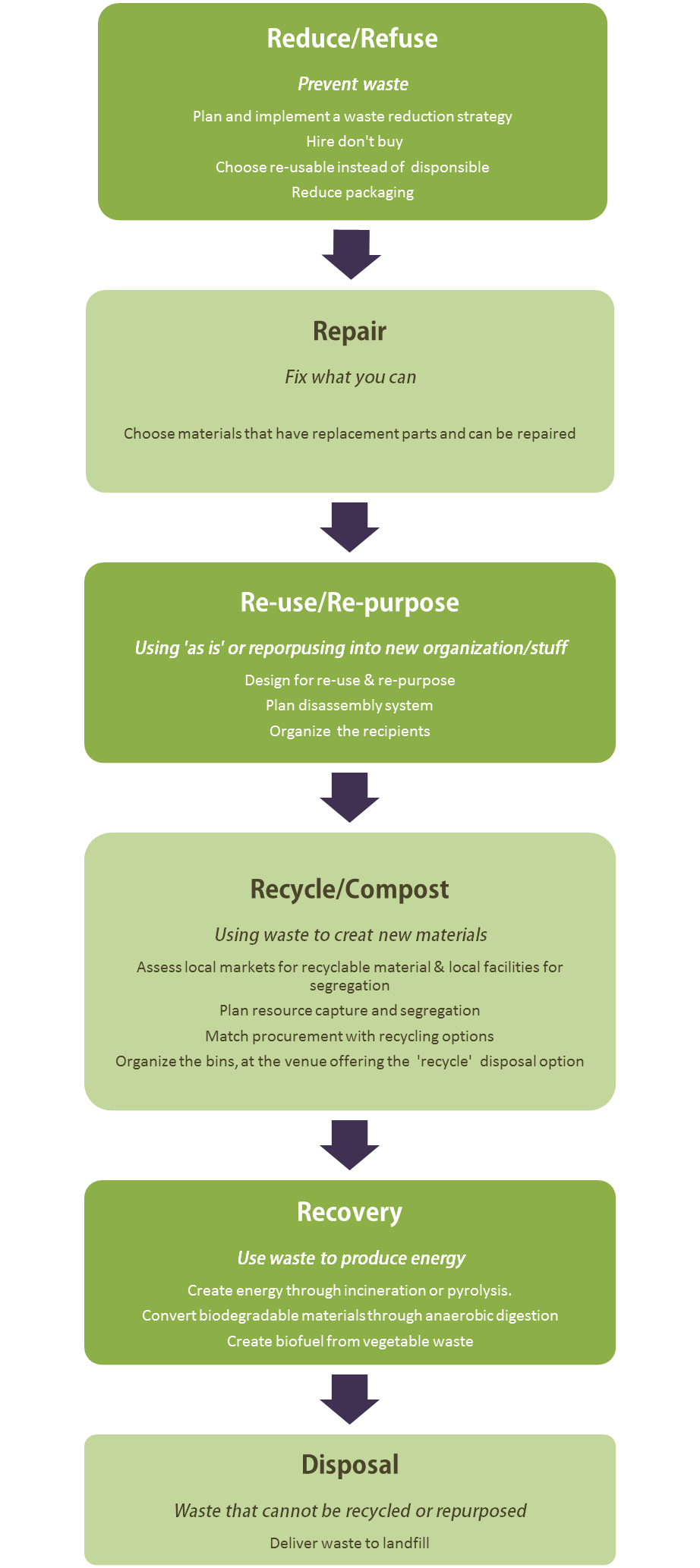
Waste Management Hierarchy
Source: Johnson et al. (2011);Jones (2018) | Author’s Edit
“For the event manager, incorporating a waste management plan into the overall event plan has become increasingly good policy.” (Bowdin et al. 2012:46).
Waste Management Timeline
Source: Jones (2018) | Author’s Edit
“Further advice for sporting events is provided by UK Sport (2002), who have also identified seven steps for ‘greening’ events (UK Sport, 2005, p. 63). These are:
Adopt a green policy
Carry out an ‘Environmental Scoping Review’ of venues and operations
Establish environmental teams
Define programmes and set appropriate targets
Implement programmes
Monitor implementation and adjust
Evaluate and publicize results programme accordingly.” (Bowdin et al. 2012:47).
References:
Bowdin, G., Allen, J., O’Toole, W., Harris, R. and McDonnell, I. (2012) Events Management. 3rd edn. Oxford: Routledge
Johnson, C., Green Festival Alliance (GFA), and Shambala Festival (2011) The Power behind Festivals: A Guide to Sustainable Power. Green Festival Alliance
Jones, M. (2018) Sustainable Event Management: A Practical Guide. 3rd ed. New York: Routledge
According to Jones and Jones “events produce large peaks in wastewater. Including grey water capture and reuse and restricting toxic substances in wastewater, and being sympathetic to local wastewater treatment facilities, are pathway towards sustainable event wastewater treatment” (2014:318)
The Figure 1 below encompasses all the criteria that must be considered and suggested actions to reduce wastewater during your event.
Figure 1: Water Management Checklist | Source: Jones and Jones 2014
Example of practices used by different events:
Boom Festival: to avoid contaminating the adjacent natural lake, notably by used water from showers, sinks and washing, they installed water-saving taps, biological control and treatment facilities for all residual water additionally to the development of their own evapo-transpiration system (Jones and Jones 2014).
2018 Russia WC: to increase water-saving in stadiums they installed two-button flushing systems for the toilets. As a one-button system with a 6L tank consume 24 litres of water for every 4 flushes and a two-button toilet bowl with 4-litre and 6-litre flushes consumes 18 litres, 1.5 litres of water are therefore saved per flush, for a total of 26,000 litres of water saved per match when the stadium is full (FIFA, 2017).
The type of venue or event, its location, size, or if it sources power from mains or temporary supply should never matter when it comes to “make sourcing and operational decisions that may reduce the demand for energy and related greenhouse gas emissions” (Jones and Jones 2014:91). Generally, powering an event concerns two parties: the venue owners; and the event organisers.
The following Figures 1 & 2, will therefore advise the elements that must be checked and potentially done.
Figure 1: Venue owner’s energy checklist | Source: Jones (2018)
Figure 2: Event Organiser’s Energy Checklist| Source: Jones (2018)
Examples of practices used by past events:
‘Green Goal’ 2006 Germany WC: Photovoltaic plants were installed for electricity generation around many stadiums to power their light systems (FIFA, 2006).
Bonnaroo Festival: the use of photovoltaic solar system supports 20% of the power needed for the festival (Jones and Jones 2014).
According to Jones (2014:170), the greenhouse effect regards “gases such as carbon dioxide, methane, ozone and water vapour” that act as insulators, and trap the heat in the atmosphere to keep the temperature of the planet. Moreover, the high levels that greenhouse gases are reaching reflect the consequence of “the famous effects of global warming and climate change” (Jones 2014:171).
Therefore, in the events industry this greenhouse gases appear in a number of sources, such as: “electricity from the grid, burning up fuel in our portable generators, gas in our kitchens, fuel in vehicles, and the big one – air travel” (Jones 2014:170). Furthermore, for the simple reason that the access to resources and circumstances of each event is different, it is difficult to advise event organiser on the best way of measuring the greenhouse gas (GHG) emissions. However, event organisers may consider using one of the measures provided in this blog, such as ecological footprint (https://sustainableeventguide.home.blog/2019/03/12/ecological-footprint/).
Nevertheless, here are some tips to reduce the GHG emissions of an event:
Reduce transport and energy demand;
Reduce overall consumption of items with high carbon footprint;
Replace fossil fuels with renewable sources of energy;
Reduce the waste created throughout the event, and keep out of the landfill the biodegradables;
And reduce the usage of water.
Reference:
Jones, M. (2014) Sustainable Event Management, 2nd edn. New York: Routledge.
The term procurement is referred to “all the steps involved in purchasing materials and services: from identifying a need, through sourcing, evaluation, and making the final supplier selection” (Jones, 2018: 220).
The sustainable procurement process, though, requires to set a certain number of environmental and socio-economic criteria, in terms of a ‘green procurement policy’ (Graci & Dodds, 2008).
Figure 1: Sustainable procurement process | Source: Jones (2018)
In detail:
Figure 2: Sustainable procurement process in detail | Source: Jones (2018)
Printing & Signage Companies: Use environmentally sound production practices
References:
Graci, S. & Dodds, R. (2008) Green Festivals and Events Guide , a How To … [online] The Icarus Foundation. Available from <http://ecoclub.com/library/epapers/15.pdf> [13 March 2019]
Jones, M. (2018) Sustainable Event Management: A Practical Guide. 3rd ed. New York: Routledge
An event can generate a lot of waste, often event materials are single use, toxic to the environment and disposable. Such flyers, plastic table cloths, decorations, balloons and so on. As Boggia et al. (2017:840), mentioned, materials production cycle “generates a significant negative environmental impact”.
Here is some tips to help your event be more sustainable:
Provide digital information about the event, promote and advertise online.
If you need to print, use 100% recycled paper or paper that has been FSC-certified for responsible tree harvesting, choose vegetable based inks instead of traditional inks.
Choose local and ethical gifts from eco-friendly materials.
Design a promotion plan with paperless.
Don’t provide items that are single use.
Avoid plastic materials.
Reuse envelopes and previous decorations when is possible.
Provide a digital presentation format.
Choose organic, low carbon, recyclable and reusable materials.
Provide an electronic registration system that allows participants to register.
Design a generic communication with no dates or specific titles, so that can be use again for the next event.
If you are not using the material to futures events, you can donate that material to local businesses.
Reference:
Boggia, A., Massei, G., Paolotti, L., Rocchi, L., and Schiavi, F. (2017) ‘A model for measuring the environmental sustainability of events’. Journal of Environmental Management [online] 206, 836-845. available from: <doi:10.1016/j.jenvman.2017.11.057> [7 March 2019]
Most of the transports are powered by fossil fuel, which contributes to the greenhouse gas emissions and also to the pollution. Transport is the “largest environmental impact for events” (Jones 2016:167), moving equipment, supplies, catering, merchandise, attendees, volunteers, and yet being sustainable it is a challenge that event organizers are facing.
Tips to reduce the impacts of travel and be more sustainable:
Choose a location that minimizes the need for travel, specially by plane or car.
Choose a venue that is close to the city center, close to public transport, and also promote the availability of the public transports.
Provide a digital map with directions on how the attendees can reach the venue by walking.
Promote cycling facilities of the city, such as local cycle lanes and routes, also provide a bike parking.
Promote and encourage car-sharing and taxi-sharing.
Limit the number of car parking spaces available on the venue.
Promote alternative fuel vehicles with low emissions, such as hybrid, electric.
Chose local caterers and suppliers to reduce transport impacts.
Reference:
Jones, M. (2018) Sustainable event management. 3rd ed. Oxon: Routledge
Most of event will provide food to their attendees. Serving food in an event is an opportunity to make connections, to bring people together to break bread. So how can we be sustainable when we talk about food?
The first step is to define which can of food it’s going to be serve, because one type of food can work for one type of event but maybe not another one. Because of many reasons, for example, this meal need to be on plate and people need to be seated to eat it? It is very important to choose the right type of food in accordance with the event.
The second step is to meet your requirement for a sustainable event. It is possible to use this list to help the event planner to organize and plan the event:
Ensure all beverage trucks use full food containers where possible (e.g. bottles rather than individual serving sizes).
Use ceramic or other packaging instead of Styrofoam or individual packages.
Ensure recycling as well as litter containers are available close to food trucks.
Avoid bottled water where possible. In some cities, local water trucks are available and will come
to your event to promote local tap water.
Ensure suppliers use only eco friendly cleaning products.
Offer suggestions on how to reduce water consumption.
Ask suppliers to use renewable energy sources rather than diesel generators where possible.
Use cloth rather than disposable cloths if applicable.
Use biodegradable cups. These are preferred over recyclable plastic.
Purchase products and services that meet environmental specifications wherever these are available
such as fair trade coffee, organic and locally grown foods.
Offer foods according to seasonal fruit and vegetables available locally.
Use domestic liquor brands if possible.
Provide information on the source of all food and beverages, especially if fair trade or local.
Donate leftover food to a charity.
Compost all used food. Ensure that compost bins are visible to all participants.
“Caterers and food stallholders that provide healthy, fresh, seasonal, local, fair, culturally appropriate, dietarily diverse and naturally grown food add to the overall sustainability credentials of your event” (Jones 2018:255). It can also be good if you offer gluten-free/coeliac, lactose-free, vegetarian and vegan options. Or Offer Halal, Kosher or Jain-appropriate meals. Offer culturally appropriate food (consider tastes of attendees, acknowledging regional preferences). It will show that you care about the attendees and you think about everyone. Using a local and seasonal food will help to reduce the greenhouse gas emission. Also from an economical point of view is a good solution to help small producer, it will also avoid a long travel ans the taste of the food will be better as well.
Figure 1: Food checklist | Source: Jones (2018)
Reference:
Jones, M. (2018). Sustainable event management. 3rd ed. Oxon: Routledge.
According to Jones and Jones (2014:179), ecological footprint is “the total equivalent biocapacity a material or a product needs to be created”. Jones (2017), added that it is an excellent mean to measure the demand of humankind on nature. In other words, the ecological footprint analysis seeks to evaluate an event’s sustainability by assessing its socio-economic impact on the environment based on a human being’s needs, such as its methods of transportation or its food and drink consumption (Clifton 2010). The Ecological Footprint Analysis is calculated as follows: I=PAT, with I as the human impact on the environment, as function of P for population, A as affluence in terms of consumption/production per capita and T for technology which represents the ecological impact per unit of consumption/production (Pernecky & Lück 2013). The ecological footprint is expressed in global hectares per capita (ghpc or gha) (Kitzes 2007; Footprint Network 2010a).
Table 1: The ecological footprint of Way out West | Source: Way out West (2013)
For instance, in 2010 the Swedish music festival Way out West determined their ecological footprint at 1 918 ghpc – the human average ecological footprint is 2.7 ghpc (Footprint Network 2010b) – and realised that food, meat in particular, was the principal environmental factor. They consequently decided to become a vegetarian event, to reduce their ecological footprint. Based on their study (see Table 1), in 2012 the ecological footprint of the festival was reduced by 23.9%, the catering impact from 62% to 37% and the footprint per visitor decreased from 0.073 to 0.05 ghpc, whilst the number of attendees increased by 19% (Way out West 2013; Jones & Jones 2014). The Ecological Footprint Analysis may therefore be a an efficient measurement method toward a more sustainable event.
References
Clifton, D. (2010) ‘A sustainable world – an ecological footprint and I=PAT perspective’. Journal of the Asia-Pacific Centre for Environmental Accountability, 16(2), 3–26.
Footprint Network (2010a) Ecological Footprint [online] available from <www.footprintnetwork.org/> [10 March 2019].
Footprint Network (2010b) Ecological Footprint and Biocapacity – 2010 release[online] available from <www.footprintnetwork.org/> [10 March 2019].
Jones, M. (2017) Sustainable Event Management: A Practical Guide. Abingdon, Oxon: Routledge.
Jones, M.L. and Jones, M. (2014) Sustainable Event Management. Hoboken: Taylor and Francis.
Kitzes, J. (2007) A Research Agenda for improving National Ecological Footprint Accounts. ‘International Ecological Footprint Conference: Stepping Up the Pace – New Developments in Ecological Footprint Methodology, Policy and Practice’. Held 8-10 May 2007 at Cardiff.
Pernecky, T. and Lück, M. (2013) Events, society and sustainability: critical and contemporary approaches. Abingdon, Oxon: Routledge.




 Sustainable Event Guide